Angus Maddison died at Neuilly to 83 years. We can read here
a beautiful portrait of his career.
Maddison is primarily the author of an incredible statistical basis necessary to understanding the modern world.
this blog were based on this statistical basis, which does not cease to inspire me. It therefore seemed essential to me to honor him.
His theoretical thinking itself has not been negligible, partly because it was one of the first to emphasize the need to consider, besides the immediate factors of growth, deeper factors, particularly institutions-which has now become a highlight
for most economists.
But his passion for quantification, his "chiffrophilie" to use his expression, which has made him one of the economists who most influenced thinking on economic growth. This passion was quantitative, in fact, led to the creation, from the late 1970s, quantitative estimates of the economic output of more extensive temporally and geographically, to cover the world since the year 1!
. (Part of the database on which this publication is based, and a list of his most significant publications are available its
By sheer force of factual evidence, a number of Maddison's data have transformed the way we look focused on the industrial revolution and the respective roles of the West and Asia (including China) in global economic output.
I would, as a tribute, highlighting some of the most remarkable.
First, Maddison's data have highlighted the incredible stability of the per capita wealth, before the industrial revolution. The stirring history policy seems, from this point of view, as a scum floating on top of an economic structure in stone. In the world before the industrial revolution, the son saw the father, that is to say as poorly, for generations. This is the Malthusian world in which G. Clark has studied the mechanisms in a book
noticed.
The industrial revolution is therefore one of the most fundamental break in human history. She was transported to a world of constant growth, where the son is always richer than the father, over a dramatic acceleration from the second half of the twentieth century.
Economic growth is fundamentally a phenomenon on the scale of recent human history. But it is also a phenomenon that has upset the balance of power between continents, countries, and cultural areas. This is the second phenomenon which have emerged as particularly remarkable work of Maddison.
The Industrial Revolution is, indeed, the daughter of Europe, and she was slow to spread elsewhere, transforming the old balance.

Asia (which here includes the Middle East) has, until the industrial revolution, largely dominated world economic output. She represented in 1000 nearly 70% (60% excluding the Middle East). In 1950, it is less than 20%!
This is because growth has been primarily a Western phenomenon, as other parts of the world have emulated with delay, and with a smaller time success.
The industrial revolution has brought with it a radical change in the balance between continents has made the world a Western world, when mankind had hitherto been dominated by Asia.

This reversal of the world is particularly noticeable if one includes all the components of the Western world. Of marginal in 1000 (14%), it represents the end of the Second World War 70% of global economic output. The world is so Western. Has since started a relative decline of the West. It is anterior to Europe in 1900 which represents half of world production, but whose relative position then decreases due to the rise of the United States
1.
The observation of the marginal nature of the West until very late in human history, and the importance of Asia, participated in the renewal of the historiography of the Industrial Revolution: it led him to criticize any analysis seeking to identify root causes, rooted in the very heart of civilization, the success of the West
2. As difficult as it is to accept our ethnocentrism spontaneous, Western civilization has long been second in the history of the world economy, without special character.
This leads to a third lesson from his Maddison data. Phase of economic history which began around 1500 is, contrary to what one thinks spontaneously in the West, a parenthesis in the history of the world. Balances its products can be only temporary: Asia, especially China, is brought back to the place that has historically been his.
The current tremendous growth of China and India should not surprise us: it is only the return of the old balance between human populations. And is still far from complete. The decline of China and India on the global scene alone was amazing. The world has been temporarily, and unusually, Western.

Indeed, although they remain dominant as late as the early nineteenth century (which had already shown the pioneering work of Paul Bairoch), China and India collapsed from that date. More than half of world production in 1800, they represent more than in 1900, approximately 5%. It was not until the 1970s that the catch of their historical position to intervene.
Retrofitting is particularly rapid in China. Yet, despite concern about its power restored, she has now regained half of its relative position over. For Maddison, it is only around 2030 that this rebalancing will end altogether. This shows the extent of transformation of the balance of power that lie ahead.
strength catch up to China is better understood, in fact, given the extraordinary distance that has long been his, and Maddison quantified.

In 1900, China has virtually disappeared from the scene world: it accounts for less than 1% of world production, after having represented almost one third. In 1950, it has the dubious distinction of being the only country in the world where, a century after the Industrial Revolution, the income per capita is lower than in 1500. Only since the death of Mao that China rejoined the world of growth of per capita income nearly two centuries after the West. This shows the magnitude of the catch that he still had to accomplish, and which is still far from complete.
_____________________________________________
1. We see, moreover, that the rise of the West before the Industrial Revolution: An important aspect of the work of Maddison is to have participated in the renewal of the historiography of the Industrial Revolution, emphasizing that growth dynamics that led to a temporality has long, beginning with deep structural transformations from the late Middle Ages in the West. Be as brutal as the industrial revolution, it is not the radical break that was long believed.
2. See, eg, in France, the recently published book by Philippe Norel, History overall economic , Seuil, 2009. For me, the debate is, in fact, wide open, especially compared to the more extreme arguments that make the Industrial Revolution a near accident. Something of Weber's thesis seems to me, in particular, to resist.


 Asia (which here includes the Middle East) has, until the industrial revolution, largely dominated world economic output. She represented in 1000 nearly 70% (60% excluding the Middle East). In 1950, it is less than 20%!
  This reversal of the world is particularly noticeable if one includes all the components of the Western world. Of marginal in 1000 (14%), it represents the end of the Second World War 70% of global economic output. The world is so Western. Has since started a relative decline of the West. It is anterior to Europe in 1900 which represents half of world production, but whose relative position then decreases due to the rise of the United States 1.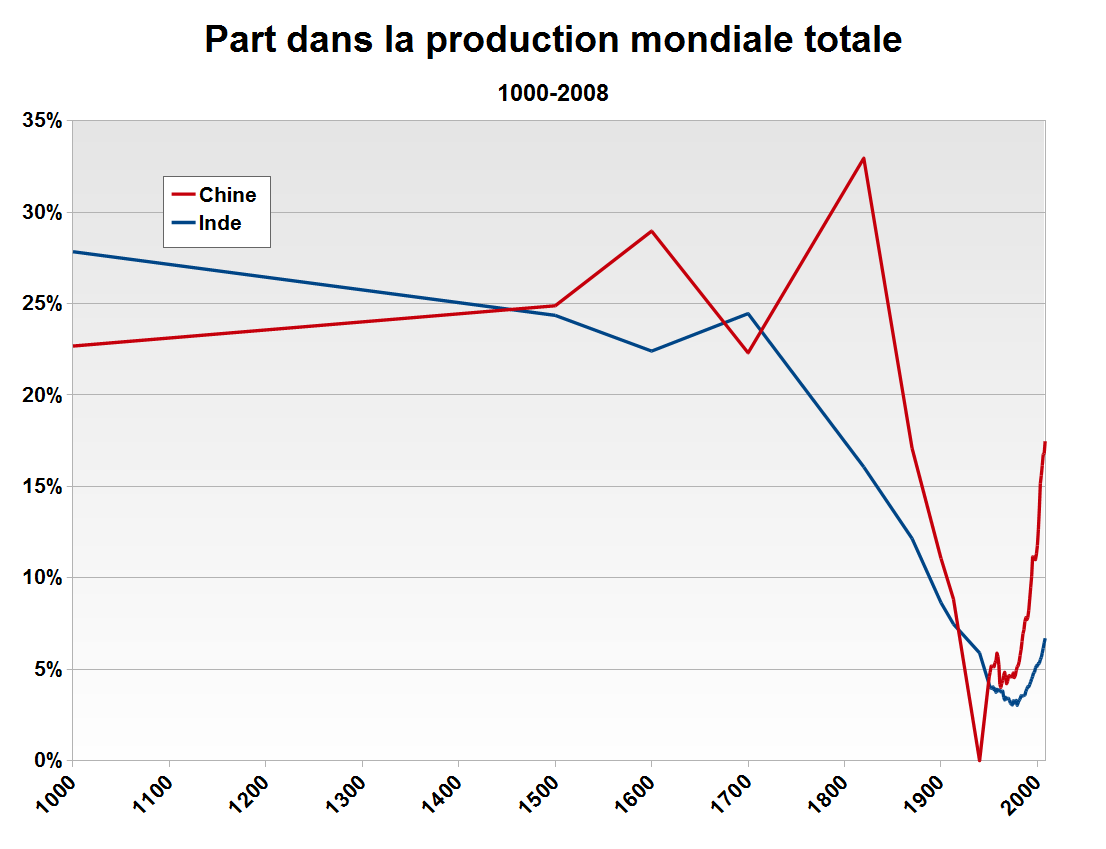
 In 1900, China has virtually disappeared from the scene world: it accounts for less than 1% of world production, after having represented almost one third. In 1950, it has the dubious distinction of being the only country in the world where, a century after the Industrial Revolution, the income per capita is lower than in 1500. Only since the death of Mao that China rejoined the world of growth of per capita income nearly two centuries after the West. This shows the magnitude of the catch that he still had to accomplish, and which is still far from complete.

